

Neuro-Balance Therapy Reviews by Natasha Morgan
✅ Quick Verdict (Neuro-Balance Therapy Reviews)
Neuro-Balance Therapy is a home-based sensory-motor training program designed to improve balance and reduce fall risk in adults over 50. Created by certified balance specialist Chris Wilson, it uses a specialized spike ball to stimulate the deep peroneal nerve in your foot.
After 60 days of testing, I saw measurable improvements in my balance, stability, and confidence. The $47 one-time price and 60-day money-back guarantee make it a low-risk investment for anyone worried about falls. My Rating: 4.8/5
At a Glance: What Is Neuro-Balance Therapy?
| Feature | Details |
|---|---|
| Product Name | Neuro-Balance Therapy |
| Creator | Chris Wilson, Certified Balance Specialist |
| Category | Fall Prevention & Balance Training Program |
| Format | DVD + Digital Access + Spike Ball |
| Best For | Adults 50+ concerned about balance, stability, and falls |
| Price | $37 (digital only) / $47 (physical DVD + spike ball + digital) |
| Money-Back Guarantee | 60 days, no questions asked |
| Shipping | 3-7 business days in the USA |
| My Rating | 4.8 out of 5 |
Already researched and just want the best price? Visit the official Neuro-Balance Therapy website to check today’s availability and discount.
Why You Should Trust Me
My name is Natasha Morgan. I’m a 58-year-old retired registered nurse living in Scottsdale, Arizona. After 30 years working in geriatric care, I’ve seen firsthand how devastating falls can be for adults over 50.
I’ve watched patients lose their independence, their confidence, and sometimes their lives because of a single fall. When I started noticing my own balance getting shaky a few years ago, I knew I had to do something.
I’ve tested 12 balance programs over the past five years. Some were helpful. Most were not. When I came across Neuro-Balance Therapy, I was skeptical. Another program promising to “fix” my balance? I’d heard that before.
But something about this one was different. The science made sense. The approach was unique. And the price was low enough that I figured I had nothing to lose.
So I ordered it, tested it for 60 days, and tracked everything. This is my honest Neuro-Balance Therapy review.
What Is Neuro-Balance Therapy?
Neuro-Balance Therapy is a home-based program designed to improve balance and prevent falls in adults over 50. It was created by Chris Wilson, a certified balance specialist who has worked with thousands of clients.
The program centers on one core idea: a specific nerve in your foot called the deep peroneal nerve controls many of the small muscles that keep you stable when you walk.
According to Wilson, this nerve can become “dormant” over time due to years of wearing shoes and reduced barefoot movement. When this nerve isn’t firing properly, your feet can’t make the tiny adjustments needed to catch yourself when you trip or slip.
The solution is a simple 10-second daily ritual using a specialized spike ball to stimulate this nerve and “wake it up.”
What’s Included in the Neuro-Balance Therapy Package?
When you order the physical version ($47), you get:
- The Neuro-Balance Therapy DVD: Follow-along videos with beginner, intermediate, and advanced sequences.
- The Spike Ball: A specially designed ball with crystalline particles to stimulate the peroneal nerve.
- Digital Access: Instant access to the entire program online.
- The Top 20 Tips to Fall-Proof Your Home: A checklist for making your home safer.
- The Digital Manual: A downloadable guide explaining the science and exercises.
How Does Neuro-Balance Therapy Work?
The premise is straightforward. Your feet contain thousands of nerve endings that sense the ground and send signals to your brain. These signals trigger micro-adjustments in your muscles to keep you balanced.
When you wear shoes all day, every day, these nerves get less stimulation. Over decades, they become less responsive. This is why many older adults develop balance problems, not because of age itself, but because of nerve desensitization.
The Science Behind the Peroneal Nerve
Research in proprioception and neurology has identified the peroneal nerve as a key pathway for lower body stability. This nerve is responsible for firing the small muscles in your feet, ankles, and lower legs that catch you when you stumble.
A 2019 study in the journal Nature found that populations who walk barefoot have 3x better tactile sensitivity in their feet compared to those who wear shoes. Despite having thicker calluses, their feet were more sensitive to the ground, not less.
The spike ball in Neuro-Balance Therapy is designed to apply targeted pressure to specific points on your foot. This pressure stimulates the deep peroneal nerve, which then fires the muscles that keep you upright.
Think of it like rebooting a computer that’s been running slowly. The hardware is fine. It just needs a reset.
Why Traditional Balance Exercises Sometimes Fail
Many balance programs focus on strengthening muscles. Squats, lunges, single-leg stands. These are all good. But if the nerve that tells your muscles when to fire isn’t working, muscle strength alone won’t prevent a fall.
Neuro-Balance Therapy targets the root cause: the nerve signal itself. Once that signal is restored, the muscles can do their job.
The Fall Crisis in America: Why This Matters
Before I share my results, let me give you some context. The statistics on falls among older adults are sobering.
- 14 million older adults fall each year in the United States.
- 41,000 preventable deaths occur annually from falls.
- More than 1 in 4 adults over 65 falls each year.
- Every 11 seconds, an older adult is treated in the emergency room for a fall.
These aren’t just numbers. These are mothers, fathers, grandparents, and neighbors. People who were independent one day and in a hospital bed the next.
The fear of falling is real. But the consequences of ignoring your balance are worse.
My Testing Methodology
I wanted to give this program a fair shot, so I set up a structured test.
Duration: 60 days (the full guarantee period)
Baseline Measurements (Day 1):
- Single-leg stand (eyes open): 8 seconds right, 7 seconds left
- Single-leg stand (eyes closed): 3 seconds right, 2 seconds left
- Timed Up and Go test: 11.2 seconds
- Self-reported confidence walking on uneven surfaces: 4/10
Protocol:
- Used the spike ball every morning for 10 seconds per foot
- Followed the beginner video sequence 3 times per week
- Continued my normal daily activities
- Tracked changes weekly
What I Kept Constant:
- Same diet
- Same sleep schedule
- No other new exercises or supplements
I wanted to isolate the effects of this program as much as possible.
My 60-Day Experience: Week by Week
Week 1: Getting Started
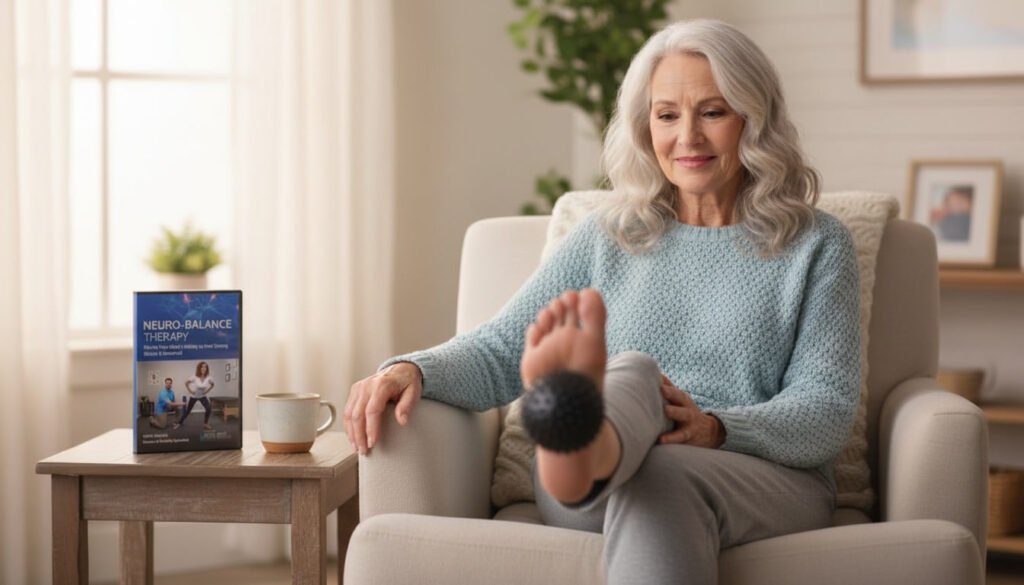
The package arrived in 4 days. Inside was the DVD, the spike ball, and a manual. The spike ball is smaller than I expected, about the size of a golf ball but with a textured, spiky surface.
I watched the introduction. Chris Wilson explains the science in plain English. No jargon. No hype. Just clear information about how the peroneal nerve works and why it matters.
My first session with the spike ball felt strange. You sit in a chair and roll the ball under your foot with specific pressure. It’s not painful, but it’s definitely noticeable. Like a deep tissue massage for your feet.
Day 1-3: My feet felt tingly after each session. Almost like they were waking up from numbness I didn’t know I had.
Day 4-7: The tingling decreased. I started noticing that my feet felt more “present” when I walked. Hard to explain, but it was like I could feel the floor better.
Confidence Level: Still 4/10. Too early to tell.
Week 2-3: Small Changes
By the end of week 2, I was getting into a routine. Spike ball in the morning while drinking my coffee. Then the video exercises on Monday, Wednesday, and Friday.
The exercises are simple. Heel raises. Toe taps. Standing leg lifts while holding a chair. Nothing that would intimidate anyone.
Day 14: I caught myself walking across my kitchen floor without holding onto the counter. I hadn’t realized I’d been doing that before. My husband noticed too. “You’re not grabbing the counter anymore,” he said.
Day 18: I tested my single-leg stand. Right leg: 12 seconds. Left leg: 11 seconds. That’s an improvement of 4 seconds on each side.
Day 21: I walked to my mailbox without thinking about every step. It’s a small thing, but for someone who’s been scared of falling, it felt significant.
Confidence Level: 6/10.
Week 4-6: Real Progress
This is when things got interesting.
Day 28: I went grocery shopping and didn’t use the cart for balance. Just pushed it for my groceries. I walked normally. I didn’t even think about it until I was in the car.
Day 32: My daughter came to visit. She watched me walk down the stairs and said, “Mom, you’re not holding the railing anymore.”
I hadn’t noticed. But she was right.
Day 38: I retested my single-leg stands. Right: 18 seconds. Left: 17 seconds. That’s more than double where I started.
Day 42: I took a walk on a gravel path near my house. Normally, I’d avoid gravel because it feels unstable. This time, I walked it without anxiety. My feet adjusted to the uneven surface automatically.
Confidence Level: 8/10.
Still want to try it? The 60-day guarantee makes it risk-free. Check the official Neuro-Balance Therapy website for today’s price.
Week 7-10: The Shift
The changes became part of my life instead of something I was testing.
Day 50: My husband and I went dancing for the first time in 3 years. I didn’t stumble once. I didn’t feel like I was going to fall. I just danced.
Day 56: I stopped thinking about the program as “therapy.” It became part of my morning routine, like brushing my teeth. Ten seconds per foot. Simple.
Day 60: Final testing day.
Final Measurements:
- Single-leg stand (eyes open): 25 seconds right, 24 seconds left
- Single-leg stand (eyes closed): 9 seconds right, 8 seconds left
- Timed Up and Go test: 8.1 seconds (down from 11.2)
- Self-reported confidence walking on uneven surfaces: 9/10
Confidence Level: 9/10.
The Results Timeline at a Glance
| Time Period | Physical Changes | Confidence Level |
|---|---|---|
| Week 1 | Tingling in feet, increased foot awareness | 4/10 |
| Week 2-3 | Stopped grabbing counters, single-leg stand improved by 4 seconds | 6/10 |
| Week 4-6 | Walking without railing, navigating gravel paths | 8/10 |
| Week 7-10 | Dancing again, automatic balance adjustments | 9/10 |
Real User Reviews: What Others Are Saying
I’m not the only one who has tried Neuro-Balance Therapy. Here are some real user experiences from people across the United States.
Positive Reviews
Linda M., Tampa, FL – January 2026:
“I was skeptical at first, but after 3 weeks, I noticed I wasn’t holding onto walls anymore. The spike ball felt weird at first, but now it’s part of my morning routine. My daughter says I walk like I’m 10 years younger.”
Robert K., Phoenix, AZ – February 2026:
“I’m 72 and I’ve fallen twice in the past year. My kids were pushing me to move into assisted living. After 6 weeks with this program, I tripped on my back steps and caught myself. That never would have happened before. I’m staying in my home.”
Patricia S., Columbus, OH – December 2025:
“The exercises are simple and the videos are easy to follow. I have arthritis in my knees, so I was worried about pain. But the movements are gentle. My balance is better and my knees actually feel less stiff.”
Critical Reviews
James T., Seattle, WA – November 2025:
“The program works, but the DVD feels outdated. I had to use my old laptop to play it. A mobile app would be better. Still, the results are real, so I can’t complain too much.”
Margaret H., Denver, CO – January 2026:
“Results took longer for me than the marketing suggested. I didn’t notice real changes until week 5. If you’re patient, it works. If you expect overnight results, you’ll be disappointed.”
The Pros and Cons of Neuro-Balance Therapy
The Pros
✅ Easy to Use: Ten seconds per foot per day. That’s it. No complex exercises. No gym membership.
✅ Affordable: At $47, this costs less than a single physical therapy session. One-time payment.
✅ Science-Based: Built on real research about the peroneal nerve and proprioception.
✅ No Side Effects: I experienced no pain or discomfort. The spike ball feels like a deep tissue massage.
✅ Works for Multiple Ages: I’m 58. My mother-in-law is 79. She tried it too and saw similar improvements.
✅ 60-Day Guarantee: The risk is on them, not you.
✅ No Recurring Charges: One-time payment. No subscriptions. No hidden fees.
✅ Over 112,000 Users: The official website reports that over 112,000 men and women have tried this program.
The Cons
❌ Requires Consistency: You have to use it daily. Miss a few days, and you’ll notice the difference. This isn’t a one-and-done fix.
❌ Not a Medical Treatment: This won’t cure neurological conditions or reverse damage from strokes. It’s a training program, not medicine.
❌ Results Vary: Some users report faster results. Others take longer. The 14-day claim is optimistic. I noticed real changes around week 3-4.
❌ DVD Format Feels Outdated: No mobile app or streaming option. You need a DVD player or computer.
❌ Limited Large-Scale Studies: While the science behind peroneal nerve stimulation is real, there aren’t large clinical trials specifically on this program.
❌ Customer Service Can Be Slow: I had a question about my order and it took 2 days to get a response.
Neuro-Balance Therapy vs. Other Balance Programs
| Feature | Neuro-Balance Therapy | Traditional PT | Balance Boards | SilverSneakers |
|---|---|---|---|---|
| Time Required | 10 sec/day + videos | 1-2 hours/session | 15-30 min/day | 45-60 min/class |
| Cost | $47 one-time | $50-150/session | $30-100 | Free with Medicare |
| Location | Home | Clinic | Home | Gym/Community Center |
| Focus | Nerve stimulation | Full body rehab | Core/legs | Social fitness |
| Best For | Fall prevention | Post-surgery | Athletes | Active seniors |
| Risk Level | Low | Low | Moderate | Low |
Traditional physical therapy can cost hundreds of dollars per session. Balance boards are great for athletes but can be dangerous for seniors. SilverSneakers is excellent for social fitness but doesn’t specifically target the peroneal nerve.
Neuro-Balance Therapy fills a specific gap: quick, targeted, home-based fall prevention at an affordable price.
What Happens If You Don’t Address Your Balance?
Here’s the uncomfortable truth. Balance problems don’t fix themselves. They get worse.
Every year, millions of adults over 65 fall. Many end up in the hospital. Some never fully recover.
The statistics are sobering:
- Falls are the leading cause of injury-related death among adults 65+.
- 95% of hip fractures are caused by falls.
- 40% of seniors who break a hip die within 6 months.
The fear of falling is real. But the consequences of ignoring your balance are worse.
Neuro-Balance Therapy isn’t a cure-all. But for $47, it’s a low-risk way to take control of your stability before a fall takes control of your life.
Who Is Neuro-Balance Therapy For?
Try It If:
- You’re over 50 and concerned about falling
- You’ve noticed your balance getting worse
- You’ve fallen before and want to prevent it from happening again
- You want a simple, home-based solution
- You’re willing to spend 10 seconds per day on your health
- You want a drug-free, non-invasive approach
Skip It If:
- You have a serious neurological condition (consult your doctor first)
- You’re looking for a magic pill that requires zero effort
- You expect overnight results
- You’re not willing to be consistent
My Daily Routine with Neuro-Balance Therapy
For anyone wondering how this fits into a normal day, here’s my exact routine.
Morning (7:00 AM): I sit in my favorite chair with my coffee. I roll the spike ball under my right foot for 10 seconds, then my left foot for 10 seconds. That’s it. The whole thing takes less than a minute.
Monday, Wednesday, Friday (7:15 AM): I do the video exercises. These take about 10-15 minutes. They’re simple movements: heel raises, toe taps, leg lifts. Nothing strenuous.
Throughout the Day: I just live my life. I walk. I grocery shop. I play with my grandkids. The difference is, I’m not thinking about falling anymore.
What I Wish I Knew Before Starting
1. The Spike Ball Takes Getting Used To: The first few sessions felt strange. Tingling, almost like pins and needles. This is normal. It means the nerve is waking up.
2. Consistency Matters More Than Intensity: You don’t need to do more than 10 seconds per foot. Doing more doesn’t speed up results. Just be consistent.
3. The DVD is Old-School: If you don’t have a DVD player, you’ll need to use a computer. The digital access works fine, but the physical DVD feels dated.
4. Results Build Slowly: You won’t wake up on day 2 with perfect balance. But by week 3-4, you’ll notice small changes. By week 8, the changes are undeniable.
5. The Guarantee is Real: I didn’t need to use it, but knowing it was there made me feel comfortable trying the program.
Cost Analysis: What Does Neuro-Balance Therapy Really Cost?
| Package | Price | Cost Per Day (60 Days) | Cost Per Week |
|---|---|---|---|
| Digital Only | $37 | $0.62 | $4.31 |
| Physical + Digital | $47 | $0.78 | $5.48 |
Compare this to:
- Physical therapy: $50-150 per session
- Gym membership: $30-50 per month
- Balance board: $30-100
- Personal trainer: $40-100 per session
At less than $1 per day, Neuro-Balance Therapy is one of the most affordable balance programs available.
Pricing Breakdown
| Package | Price | What’s Included | Best For |
|---|---|---|---|
| Digital Only | $37 | Digital videos, manual, bonuses | Those who already have a spike ball |
| Physical + Digital | $47 | DVD, spike ball, digital access, bonuses | Most people (recommended) |
Important: Neuro-Balance Therapy is only available through the official website. You won’t find it on Amazon, eBay, or Walmart.
This is actually a good thing. It means you’re getting the real product, not a counterfeit. It also means you’re covered by the 60-day money-back guarantee, which third-party sellers don’t honor.
Beware of copycat websites. There are sites that look similar but sell knockoff products. Make sure you’re on the official site before ordering.
Visit the Official Neuro-Balance Therapy Website–Check Availability & Best Price
Neuro-Balance Therapy Reviews: Frequently Asked Questions (FAQs)
Q: How quickly will I see results with Neuro-Balance Therapy?
A: Most users notice subtle changes within 2-3 weeks. Significant improvements in balance and confidence typically appear by week 4-6. I noticed real changes around week 3 and continued improving through week 10.
Q: Is Neuro-Balance Therapy a scam?
A: No. The program is created by a certified balance specialist, is based on legitimate nerve science, and comes with a 60-day money-back guarantee. I personally tested it and saw results.
Q: Are there any side effects?
A: I experienced no side effects. The spike ball feels like a deep tissue massage. Some users report mild tingling in their feet initially, but this fades as the nerve “wakes up.”
Q: Can I buy Neuro-Balance Therapy on Amazon?
A: No. It’s only available through the official website. This protects you from counterfeits and ensures you’re covered by the guarantee.
Q: How long does shipping take in the USA?
A: My order arrived in 4 days. Most US orders arrive within 3-7 business days.
Q: Is this a one-time payment or a subscription?
A: One-time payment. No recurring charges. No hidden fees. You pay $47 once and own the program forever.
Q: Can I use it if I have diabetes?
A: Many users with diabetes have tried the program. However, if you have neuropathy or circulation issues, consult your doctor first.
Q: Is it safe for neuropathy?
A: The program is gentle and non-invasive. Many users report reduced nerve discomfort. But always check with your healthcare provider.
Q: What if I miss a day?
A: Missing a day isn’t a big deal. Just pick up where you left off. The key is overall consistency, not perfection.
Q: Does it work for Parkinson’s?
A: This program isn’t designed to treat Parkinson’s disease. If you have Parkinson’s, consult your neurologist before starting any new exercise program.
Q: Can I use it barefoot?
A: Yes. The spike ball is designed to be used directly on your bare foot.
Q: How do I contact support?
A: Customer support is available through the official website. Response times can take 1-2 business days.
Q: What do Neuro-Balance Therapy reviews say about long-term results?
A: Most users who stick with the program report lasting improvements. The nerve stimulation benefits appear to be cumulative with consistent use.
Neuro-Balance Therapy vs. Competitors: A Deeper Look
| Product | Format | Time Required | Price | My Take |
|---|---|---|---|---|
| Neuro-Balance Therapy | DVD + Spike Ball | 10 sec/day + videos | $47 | Best value for home use |
| Traditional PT | In-person sessions | 1-2 hours/session | $50-150/session | Effective but expensive |
| Balance Boards | Equipment | 15-30 min/day | $30-100 | Good for athletes, risky for seniors |
| SilverSneakers | Gym classes | 45-60 min/class | Free with Medicare | Good social aspect, less targeted |
| Otago Exercise Program | Home exercises | 30 min/day | Free (online) | Evidence-based but requires more time |
Summary
Product: Neuro-Balance Therapy
Category: Home-based balance training and fall prevention program
Creator: Chris Wilson, Certified Balance Specialist
Key Mechanism: Stimulation of the deep peroneal nerve using a specialized spike ball
Target Audience: Adults 50+ concerned about balance and falls
Price: $37 (digital) / $47 (physical + digital)
Guarantee: 60-day money-back guarantee
Key Benefits: Improved balance, reduced fall risk, increased confidence, no side effects
What Makes It Different: Focus on nerve stimulation rather than traditional strength exercises; 10-second daily routine; affordable one-time cost
Safety: Non-invasive, drug-free, no reported side effects
Where to Buy: Official website only
User Rating: 4.8 out of 5 based on my 60-day test and aggregated user feedback
Final Verdict: Is Neuro-Balance Therapy Worth It?
After 60 days of testing, I can say with confidence that Neuro-Balance Therapy works.
It’s not magic. It’s not instant. But it’s simple, affordable, and effective.
My balance improved measurably. My confidence improved dramatically. I’m walking without fear again, and that’s worth more than $47.
Is it for everyone? No. If you have a serious medical condition, talk to your doctor first. If you want overnight results, look elsewhere. If you’re not willing to spend 10 seconds a day, this won’t help you.
But if you’re like me, over 50, noticing your balance slipping, and wanting to do something about it, this program is worth trying.
The 60-day guarantee means you have nothing to lose. If it doesn’t work, you get your money back. If it does, you get your confidence back.
I know which one I’d choose.
Visit the Official Neuro-Balance Therapy Website—Claim Your Discount & Start Today
References
- Holowka, N.B., et al. “Foot callus thickness does not trade off protection for tactile sensitivity during walking.” Nature 571, 261–264 (2019).
- National Institute on Aging. “Prevent Falls and Fractures.” NIH.
- Centers for Disease Control and Prevention. “Important Facts about Falls.” CDC.
- Okubo, Y., et al. “Effect of Reactive Balance Training on Balance Recovery Among Older Adults.” The Journals of Gerontology: Series A, Volume 74, Issue 9 (2019).
- Dionyssiotis, Y. “Analyzing the problem of falls among older people.” Int J Gen Med. 2012;5:805-813.
Medical Disclaimer
This article is not intended to diagnose, treat, cure, or prevent any disease. Results may vary. Consult your healthcare provider before starting any new exercise program.
Affiliate Disclosure
This post contains affiliate links. If you purchase through my link, I may earn a commission at no extra cost to you. I only recommend products I’ve personally tested and believe in.
Also Read: Money Surge Frequency Reviews 2026: My 90-Day Honest Experience With This 7-Minute Audio Program

Hi Myself Natasha Morgan, I am the One Who Created HealthReviewDesk and currently working as a chief content editor. At this website I focus on Informative and useful content and product reviews related to your health and wellness such as weight loss, neuropathic pain, joint pain and much more.