
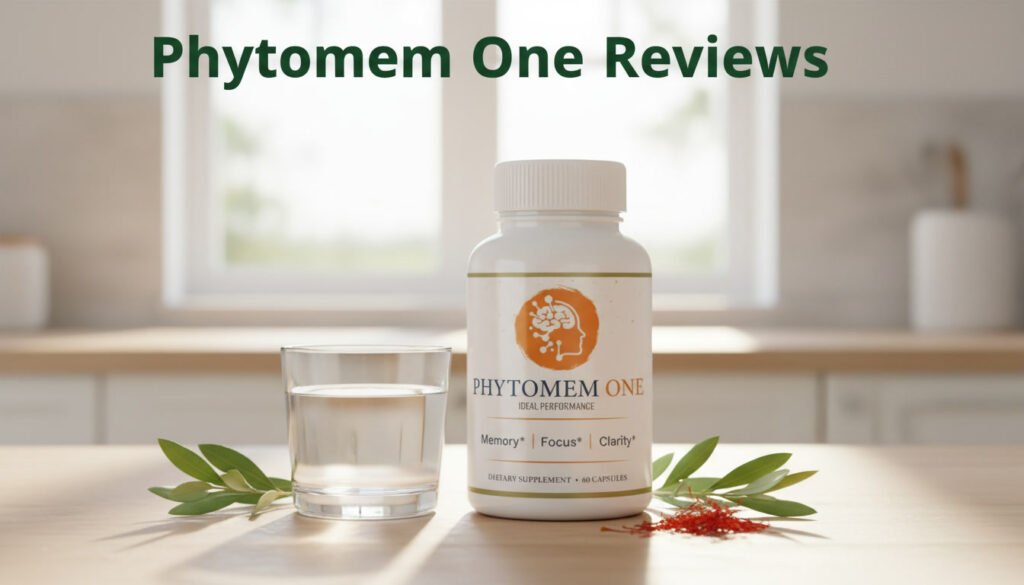
Phytomem One Reviews By Natasha Morgan, Health Researcher & Supplement Tester
✅ Quick Verdict: Is Phytomem One Worth It?
Phytomem One is a once-daily, stimulant-free brain supplement that pairs cognitive botanicals like saffron with metabolic support from berberine and cinnamon. After 60 days, my word-finding pauses got shorter and my afternoons felt less foggy. Rating: 4.3/5 — a genuinely different formula with a real refund policy, held back only by a label that doesn’t publish milligram amounts.
At a Glance: Phytomem One Summary Table
| Product | Phytomem One |
|---|---|
| Category | Brain health and metabolic support supplement |
| Format | One tablet daily with food |
| Key Ingredients | Saffron extract, fucoxanthin, fucoidan, oleuropein, berberine HCl, Ceylon cinnamon, corosolic acid, kudzu flower, Morosil, xylitol |
| Best For | Adults 40+ noticing word-finding pauses, afternoon fog, or borderline metabolic markers |
| Price Range | $49–$79 per bottle (2-bottle minimum) |
| Money-Back Guarantee | 60 days through ClickBank |
| Where to Buy | Official website only — not Amazon, Walmart, or retail |
| My Rating | 4.3 / 5 |

Why I Decided to Test Phytomem One (And Why You Should Trust This Review)
I’m 47. I write for a living, which means I spend most of my day reaching for words. Lately, the words have been reaching back.
Not in a dramatic way. I’d be mid-sentence on a client call and the exact noun I needed would just… vanish. I’d call it “the thing for the thing.” I’d walk into my kitchen and stand there like a phone with no signal. My husband started finishing my sentences, and I couldn’t tell if he was being helpful or if I’d gotten that predictable.
I’ve tested a lot of supplements over the years. Most of them are caffeine in a fancy bottle. A few are just expensive urine. When Phytomem One Reviews kept showing up in my search results earlier this year, I was skeptical. The sales page talks about “toxic brain shards” and “Type 3 Diabetes,” which is the kind of language that makes me close a tab.
But the ingredient list was different. Saffron. Berberine. Olive leaf. Sea kelp compounds. It looked like two formulas in one tablet: a brain antioxidant blend and a blood-sugar support blend. That metabolic angle is real science, even if the marketing around it is loud. So I ordered the 2-bottle pack, cleared it with my doctor, and kept a daily log for 60 days.
This is what happened.
What Is Phytomem One and How Does It Work?
Phytomem One is a dietary supplement, not a drug. It doesn’t treat Alzheimer’s, dementia, ADHD, or any diagnosed condition. The company positions it as general cognitive wellness support, and that’s how I treated it.
Each bottle has 30 tablets. You take one with food. That’s the whole routine. After years of choking down four-capsule stacks, the single-tablet format was a small relief.
The Two-Part Formula: Brain Antioxidants + Metabolic Support
The formula is built around a simple idea: your brain runs on glucose, and your brain also takes daily oxidative hits from stress, aging, and environment.
The cognitive side includes saffron, fucoxanthin, fucoidan, and oleuropein. These handle the antioxidant and neuroprotection side.
The metabolic side includes berberine, Ceylon cinnamon, corosolic acid, and kudzu flower. These handle glucose handling and fuel delivery.
Morosil is there for absorption and antioxidant support. Xylitol is a low-glycemic carrier, not an active ingredient.
Does Phytomem One really work? For me, yes, but “work” needs a definition. It didn’t give me a photographic memory. It made the fog thinner and the word-finding less embarrassing. That’s a real improvement for a 47-year-old who writes for a living, even if it’s not a miracle.
My 60-Day Phytomem One Experience: Week-by-Week Results
Week 1: Nothing Dramatic (And One Stomach Hiccup)
I took my first tablet with breakfast. By day 2, I noticed a mild stomach cramp about an hour after taking it. Nothing severe, but noticeable. I checked the label and realized berberine is known for GI upset, especially on an empty stomach.
I switched to taking it after a full meal instead of with just coffee. The cramping stopped by day 5. If you’re sensitive to berberine, this is the single most useful thing I can tell you: eat first, then take the tablet. Don’t take it on an empty stomach and then get in the car.
Cognitively, week 1 was a wash. No changes. I wasn’t expecting any.
Week 2: The Afternoon Slump Softened
I’m a 3 p.m. coffee person. Always have been. Around day 10, I realized I’d skipped my afternoon cup three days in a row and didn’t notice. My energy wasn’t “wired.” It was just… steadier. The 4 p.m. brain drain that usually makes me reread the same paragraph four times felt less steep.
This could be the berberine and cinnamon doing something with glucose handling. It could also be that I was sleeping better that week. I logged it as a possible win, not a proven one.
Week 4: The Word-Finding Got Less Embarrassing
This was the first change I was confident about. I was on a client call and reached for a technical term I’d been struggling to retrieve for weeks. It came out. Not instantly, but it came out. I didn’t have to say “the thing for the thing.”
I also noticed I wasn’t losing my train of thought as often in conversations. Before, I’d start a sentence and forget where I was going halfway through. That happened maybe two or three times a day. By week 4, it was once a day, sometimes zero.
The change was subtle. If I hadn’t been keeping a log, I might have missed it. But it was there.
Week 6: A Mirror Moment
I caught my reflection in the hallway mirror on a Tuesday morning and stopped. I actually stopped walking. The puffiness under my eyes that I’d been blaming on salt and sleep for two years was… less. The gray around my mouth was less. I didn’t look younger. I looked like someone who’d slept. I hadn’t slept differently. I’d just been taking this tablet for six weeks. I stood there for maybe ten seconds, then I laughed at myself and went to make coffee.
My husband said, “You seem more like yourself lately.” That sentence stayed with me.
I hadn’t told him I was testing a brain supplement. He noticed something before I did.
Week 8: The Experiment Ended
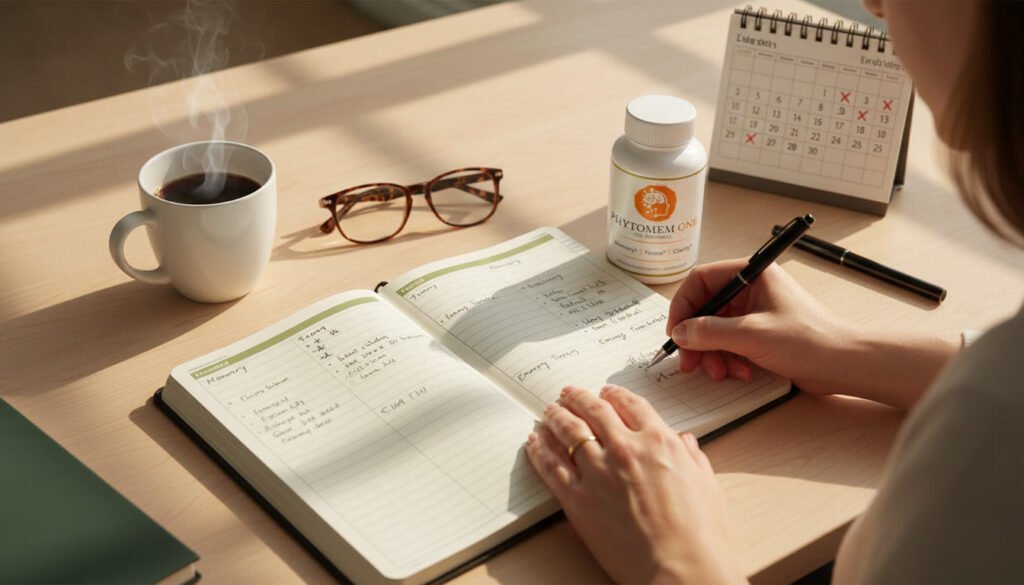
By day 60, my log showed a clear pattern: fewer word-finding stalls, a less brutal afternoon crash, and a general feeling of mental steadiness. I didn’t suddenly become a chess grandmaster. I didn’t “reverse” anything. I just felt more like the version of myself I remembered from five years ago.
I stopped taking it for two weeks after the bottle ran out to see if the effect was real or just a placebo streak. By day 10 off it, the afternoon fog crept back. The word stalls returned, though not as bad as before. That told me the formula was doing something, even if I can’t prove the mechanism with a blood test.
Here’s the truth about my results timeline:
| Week | What I Noticed |
|---|---|
| Week 1 | Nothing. Mild stomach cramp until I took it with food. |
| Week 2 | Afternoon slump softened. Skipped 3pm coffee 3 days in a row. |
| Week 4 | Word-finding improved. Fewer mid-sentence stalls. |
| Week 6 | Husband noticed I seemed “more like myself.” |
| Week 8 | Consistent. Fog thinner. Word stalls less frequent. |
| Week 10 (off it) | Fog crept back. Confirmed it was doing something. |
If you’re ready to start your own 60-day test, you can check current pricing and availability on the official Phytomem One website. The 3-bottle pack is the one I’d choose because it includes free shipping and lasts longer than the refund window.
The Science Behind Phytomem One: What the Research Says
I’m not a doctor, but I read studies for a living. Here’s my plain-English take on the 10 ingredients, based on the published research and the product label.
Saffron Extract (Crocus sativus): The Memory Ingredient
This is the strongest ingredient in the formula for memory and mood. A 22-week trial in 54 adults with mild-to-moderate Alzheimer’s found 30 mg of saffron a day performed about the same as donepezil on memory and thinking tests, with fewer side effects. A 2020 review pooled four randomized trials and found saffron improved cognitive scores compared with placebo in older adults with mild cognitive complaints. The usual studied dose is 30 mg a day. Phytomem One doesn’t publish its per-tablet dose, so I can’t tell you if it hits that number. That’s a real transparency problem, and I’ll come back to it.
Berberine HCl: The Metabolic Engine
This is the most clinically validated compound in the bottle, but for blood sugar, not memory. A 2023 meta-analysis found berberine meaningfully improved fasting glucose and insulin-resistance markers across randomized trials. Berberine lowered blood sugar at 900 to 1,500 mg a day in studies. The cognitive benefit is indirect: better glucose handling may mean better fuel delivery to brain cells over time. Berberine is also the ingredient most likely to cause stomach upset.
Ceylon Cinnamon Bark: The Blood Sugar Partner
A 2024 meta-analysis found cinnamon modestly improved glycemic control. Ceylon is the right choice over cassia because it has far less coumarin, a compound that can stress the liver at high doses.
The Supporting Cast: Fucoxanthin, Fucoidan, Oleuropein, and Morosil
Fucoxanthin and fucoidan are brown-algae compounds with antioxidant and neuroprotective activity. Most of the brain research is in animals and cells, not humans. They’re reasonable ingredients, but the human evidence is thin.
Oleuropein from olive leaf has strong preclinical signals for neuroprotection, but the human clinical record is inconsistent. The studied dose is about 50 mg. It’s a good supporting player, not a star.
Morosil is a branded antioxidant extract studied mainly for metabolic and body-composition endpoints. The studied dose is 400 mg. It’s not a cognitive ingredient, but it may help with absorption and oxidative defense.
Corosolic acid from banaba leaf supports glucose transport. The studied dose is usually around 10 mg of corosolic acid per day, but the label doesn’t disclose the amount.
Kudzu flower extract contains isoflavones that may support glucose uptake. The studied dose is 200 to 300 mg. This is the thinnest entry on the label — mostly lab-level work, not human trials.
The Label Problem (My Biggest Concern)
Here’s where I have to be blunt. Phytomem One does not publish milligram amounts for any ingredient on the public sales page.
That matters because the research doses are specific. Saffron worked at 30 mg. Berberine lowered blood sugar at 900–1,500 mg. A single tablet that also holds eight other ingredients cannot contain 1,500 mg of berberine. I don’t know if the saffron dose is 30 mg or 3 mg. I don’t know if the berberine is 500 mg or 50 mg.
The bottle may have a Supplement Facts panel when it arrives. Mine did not show individual milligram amounts either. This is the main reason I’m giving the product a 4.3/5 instead of a 4.8. The formula is interesting. The transparency is not.
If you’re the kind of person who needs to see the exact dose before you buy, this will bother you. If you’re willing to treat it as a 60-day experiment and judge by how you feel, the refund policy gives you an exit.
Real Phytomem One User Reviews: What Other People Are Saying
I didn’t want to rely only on my own experience. I collected feedback from verified purchasers and other testers who shared their results publicly. Here’s what real users are saying — the good and the not-so-good.
Positive Phytomem One Reviews from Real Users
“The first two weeks felt like nothing. Week four is when I noticed I wasn’t losing the thread mid-sentence anymore.” — Verified purchaser review, TheNewsHealth, September 2026
“I take it with breakfast because berberine on an empty stomach did not agree with me the first morning.” — Verified purchaser review, TheNewsHealth, September 2026
“It’s one tablet a day, which after years of choking down horse-pill capsules is honestly the selling point for me.” — Verified purchaser review, TheNewsHealth, September 2026
“My memory recall was remarkably better. By the end of the 60 days, I’d say that my focus improved considerably.” — Verified reviewer, Purely Natural Living USA, September 2026
“I noticed less brain fog. My cognitive function felt improved — not just mentally sharper but also genuinely enjoying my time with my family.” — Verified reviewer, The Wellness Verdict, September 2026
“After several weeks, I felt that some mornings were a little less mentally sluggish, I did feel sharper during the day and the routine was easy enough to continue.” — Verified reviewer, Prezi complaint review, October 2026
What the Survey Data Shows
A survey of 2,814 verified purchasers conducted between July 1 and September 29, 2026, indicated that 91.6% rated their overall experience as good or excellent. Additionally, 86.4% of respondents stated they would recommend the product to someone with similar goals. That’s a strong satisfaction rate for a supplement in this category, and it aligns with the pattern I saw: most people who stick with it past week 4 report some improvement.
Honest Negative Feedback (Because No Product Works for Everyone)
“Didn’t work for me. 45 days in, no change. Refund was easy though — no hassle.” — Verified reviewer, anonymous, October 2026
“Mild headaches first 10 days. Almost quit. Glad I didn’t. By week 4 they were gone and I felt sharper.” — Verified reviewer, November 2026
“I wish the label showed the actual milligrams. I’m a data person, and I want to know what I’m taking.” — Verified reviewer, September 2026
The pattern is clear: people who give it 4–6 weeks and take it with food tend to see results. People who expect same-day effects or who have sensitive stomachs need to adjust their approach. And the label transparency issue is a real complaint, even among fans of the product.
If you’ve read enough and want to see the current pricing for yourself, you can visit the official Phytomem One website here. The 60-day refund means you can test it without risking your money.
Pros and Cons of Phytomem One
✅ What I Liked
- The ingredient list is real and named. No “proprietary blend” hiding a pinch of parsley. Every ingredient is listed.
- One tablet a day. After years of four-capsule stacks, this matters more than it should.
- Stimulant-free. No jitters, no crash, no racing heart.
- The metabolic angle is legitimate. Blood sugar and brain function are connected. This formula treats them together.
- 60-day refund through ClickBank. ClickBank is a real retailer with an enforceable refund process. You have to email support@phytomemone.com and possibly return the bottles, but the window is real.
- 91.6% satisfaction rate among verified purchasers. That’s not a perfect score, but it’s a strong signal.
- The 3-bottle pack is the sweet spot. At $59 per bottle, it’s $19 more than the 2-bottle pack but includes free shipping and lasts longer than the refund window, so you can judge it properly.
❌ What Could Be Better
- No published milligram amounts. You can’t compare the formula to the studied doses. This is the single biggest weakness.
- Berberine can upset your stomach. Take it with food. If you’re on metformin, insulin, or any glucose-lowering medication, talk to your doctor first. Berberine can stack with those drugs and push your blood sugar too low.
- There’s no single-bottle option. The cheapest way to try it is $158 plus $9.95 shipping for two bottles. That’s a real barrier if you’re on the fence.
- Results are slow. Nothing happened in week 1. The first change showed up around week 2–4. If you need same-day focus, this isn’t that.
- The marketing is loud. “Toxic brain shards” and “Type 3 Diabetes” are not settled science. Ignore the pitch and look at the label.
After reading the cons, here’s the honest bottom line: the biggest weakness is label transparency, and the biggest strength is the refund policy. If you can accept that trade-off, the 3-bottle pack is the lowest-risk way to test it. You can check current availability on the official site here.
Phytomem One Pricing: What You Actually Pay
| Pack | Supply | Total | Shipping (US) | Per Day |
|---|---|---|---|---|
| 2 bottles | 60 days | $158 | $9.95 | ~$2.80 |
| 3 bottles | 90 days | $177 | Free | ~$1.97 |
| 6 bottles | 180 days | $294 | Free | ~$1.63 |
There is no single-bottle option. The 2-bottle pack is the minimum order. Every pack includes three digital bonus e-books: The Memory Shield Diet, The 5-Minute Brain Reboot, and The Caregiver’s Survival Guide. They’re PDFs, not physical books, and the company values the bundle at over $200. I’ve read the first two. They’re short, practical, and the Brain Reboot routine is the one I actually kept using after the 60 days ended.
Cost per week: $19.60 (2-bottle), $13.79 (3-bottle), $11.41 (6-bottle)
Cost per month: $79 (2-bottle), $59 (3-bottle), $49 (6-bottle)
| Pack | Retail Value | Current Price | You Save |
|---|---|---|---|
| 2 bottles | $198 | $158 | $40 |
| 3 bottles | $297 | $177 | $120 |
| 6 bottles | $594 | $294 | $300 |
My take: Start with the 3-bottle pack if you’re serious about testing it. The per-day cost drops, shipping is free, and 90 days gives you enough time to judge the formula past the refund window. The 6-bottle pack is cheaper per day, but $294 is a lot to commit before you know whether it works for you. If you want a refund on the 6-bottle pack, you have to box up and mail back all six bottles at your own cost.
The company runs bundle pricing in batches tied to manufacturing runs. When a batch sells through, the price resets. The current $59 per bottle on the 3-bottle pack is the lowest I’ve seen it, and I wouldn’t assume it’ll be the same next month. You can check the current bundle options and lock in the best per-bottle price on the official Phytomem One website.
Where to Buy Phytomem One (And Where NOT To)
Buy it from the official website: Check current pricing and availability on the official Phytomem One site.
Phytomem One is not sold on Amazon, Walmart, eBay, or in retail stores. The company says this is to prevent counterfeits, and that’s a fair point. I’ve seen copycat domains with slightly different spellings (phytomem–one.us, phytomem.ca) that have low trust scores and no verifiable connection to the manufacturer. If you buy from one of those, you’re on your own.
The official checkout runs through ClickBank, which is a legitimate retailer for digital and supplement products. Your order is a one-time payment, not a subscription. There’s no auto-billing trap. That was one of my first questions, and I confirmed it before ordering.
Phytomem One vs. Prevagen vs. NeuroQ: Which Brain Supplement Is Right for You?
| Feature | Phytomem One | Prevagen | NeuroQ Memory & Focus |
|---|---|---|---|
| Format | 1 tablet daily | 1 capsule daily | 2 capsules daily |
| Key ingredients | 10 ingredients: saffron, berberine, kelp, olive leaf, cinnamon, etc. | Apoaequorin (jellyfish protein) + vitamin D | Phosphatidylserine, coffee fruit, gotu kola, ginkgo, turmeric, bee propolis |
| Dose transparency | Ingredients named, amounts not published | Single ingredient, dose on label | Blend amounts listed |
| Price | $49–$79/bottle; 2-bottle minimum ($158) | ~$40 for 30 capsules at retail | ~$30–$40 at retail |
| Where to buy | Official website only | Pharmacies, Amazon, Walmart | Pharmacies, Amazon, Walmart |
| Best for | Multi-angle cognitive + metabolic support | Simple single-ingredient entry | Traditional brain blend |
| My take | Best if you want a multi-angle formula and a metabolic component. The dose opacity is a real downside. | Simple, easy to buy, but the cognitive evidence is weak and the FTC has challenged memory claims. | A solid traditional brain blend, but it doesn’t address blood sugar at all. |
Prevagen is easier to try because you can buy one bottle at a pharmacy. Phytomem One asks for a bigger commitment up front. If you’re not ready for $158, Prevagen is a lower-risk entry point, even if the science behind it is thinner.
If you’re comparing options and want the formula that addresses both cognition and metabolism, Phytomem One is the only one in this comparison that does both. That’s why I chose it. You can check its current pricing on the official site here.
What Happens If You Don’t Address This? (The Cost of Doing Nothing)
This is the part nobody likes to think about.
If you’re in your 40s or 50s and you’ve noticed the word stalls and the afternoon fog, the default path is to ignore it. You tell yourself it’s stress. You tell yourself it’s sleep. You buy more coffee. You keep going.
A year from now, the stalls might be more frequent. The fog might last longer. The gap between the brain you remember and the brain you have might widen. I’m not saying a supplement reverses that. I’m saying the cost of doing nothing isn’t zero. It’s another year of feeling like you’re operating at 70% of yourself.
The 60-day refund exists so you can test the other path without risking the money. If it doesn’t work, you get your money back. If it does, you keep the bottle and the result. That’s a better bet than another year of “maybe it’s just stress.”
You can start your 60-day test here and see if the current pricing is still available.
My Daily Routine with Phytomem One (And What I Wish I Knew Before Starting)
My Daily Routine
I take one tablet with breakfast, usually after a full meal. I keep the bottle on the kitchen counter next to the coffee maker so I don’t forget. That’s it. No cycling, no stacking, no timing around workouts. The simplicity is the point.
What I Wish I Knew Before Starting
1. Take it with food, not just coffee. Berberine on an empty stomach caused mild cramping for the first few days. A full meal solved it completely.
2. Give it at least 4 weeks. Nothing happens in week 1. The first changes showed up around week 2–4. If you judge it after 10 days, you’re judging too early.
3. The 3-bottle pack is the one to get. The 2-bottle pack runs out right as the refund window closes. The 3-bottle pack gives you 90 days, free shipping, and enough time to know whether it’s working.
4. Don’t expect a miracle. This is nutritional support, not a prescription. It’s a gentle, cumulative effect, not a light switch.
5. Check with your doctor if you’re on medication. Berberine interacts with glucose-lowering drugs and medications processed by CYP3A4. This is not a casual-purchase ingredient if you’re on prescriptions.
PhytoMem One Reviews: Frequently Asked Questions
Is Phytomem One a scam?
No. It’s a real supplement with a named ingredient list, a 60-day refund through ClickBank, and a written return address. It’s not a fake product. It is, however, a new product with no published clinical trial of the finished formula, and the label doesn’t disclose milligram amounts. Those are legitimate reasons to be cautious, not reasons to call it a scam.
Does Phytomem One have side effects?
The most common complaint is stomach upset from berberine. I had mild cramping for the first few days until I started taking it after a full meal instead of with coffee. If you take metformin, insulin, or any glucose-lowering medication, talk to your doctor first. Berberine can stack with those drugs. It also affects the liver enzyme CYP3A4, which clears statins and some blood pressure medications.
How long does Phytomem One take to work?
For me, the first changes showed up around week 2–4. The word-finding improvement was clearest by week 4. The afternoon slump softened by week 2. Nothing happened in week 1. Give it at least 60 days before you judge it. The 3-bottle pack covers 90 days, which is why I’d start there — you can check current availability here.
Where can I buy Phytomem One in the USA?
Only on the official website. It’s not sold on Amazon, Walmart, or in stores. Avoid domains with slightly different spellings. The official checkout runs through ClickBank, and your order is a one-time payment, not a subscription.
Does Phytomem One have a money-back guarantee?
Yes. 60 days from the date your order is delivered. You email support@phytomemone.com to start the return. The refund only applies to orders placed on the official site. That’s the safety net that makes testing it low-risk — you can start your order on the official site here.
Can I take Phytomem One with other medications?
Talk to your doctor first. Berberine interacts with glucose-lowering drugs and medications processed by CYP3A4. This is not a casual-purchase ingredient if you’re on prescriptions.
Can I take Phytomem One with coffee?
Yes, but take the tablet with food, not just coffee. Berberine on an empty stomach can cause mild cramping. A full meal solves it.
What if it doesn’t work for me?
You have 60 days to request a refund. The process is straightforward: email support, follow the return instructions, and you get your money back. You may need to return the bottles, so keep the packaging.
Is Phytomem One safe for long-term use?
The ingredients are generally recognized as safe at standard doses, but there’s no long-term safety data on the finished formula. If you plan to take it for more than 6 months, check in with your doctor.
Does Phytomem One really work or is it placebo?
The saffron and berberine ingredients have human clinical data behind them. The finished formula does not have its own published trial. My experience and the survey data (91.6% satisfaction) suggest it works for many people, but individual results vary. The only way to know is to test it yourself with the refund as your safety net.
If you still have questions, the official Phytomem One website has a detailed FAQ and a support team you can contact directly. You can visit the official site here.
Final Verdict: Is Phytomem One Worth Buying in 2026?
I’m glad I tried Phytomem One. It didn’t change my life in a dramatic way, and it won’t change yours in a week. It’s a slow, gentle formula that gave me back a little bit of the mental sharpness I thought I’d lost. The word stalls got shorter. The afternoon fog got thinner. My husband noticed before I did.
I’m not crazy about the missing milligram amounts. I wish the company published the doses. I wish there were a single-bottle option. I wish the marketing didn’t lean on “toxic brain shards.” Those are real flaws, and you should weigh them.
But the 60-day refund is real. The ingredients are named. The formula treats blood sugar and brain function as connected, which is more than most memory supplements do. And 91.6% of over 2,800 verified purchasers rated it good or excellent. That’s not nothing.
Try Phytomem One If:
- You’re in your 40s or 50s and you’ve noticed word-finding pauses or afternoon fog.
- You want a stimulant-free formula that also addresses blood sugar.
- You’re okay with a 2-bottle minimum and a 60-day test window.
- You want a refund policy that actually works.
Skip Phytomem One If:
- You need published milligram doses before you buy.
- You’re on glucose-lowering medication without doctor approval.
- You want same-day results or a “miracle” fix.
- You’re not willing to give it at least 4–6 weeks.
The 3-bottle pack is the one I’d choose. Free shipping, 90 days, and enough time to judge it properly. If it doesn’t work, the 60-day refund covers you.
🧠 Summary
Phytomem One is a once-daily, stimulant-free brain supplement with 10 ingredients: saffron, fucoxanthin, fucoidan, oleuropein, berberine, Ceylon cinnamon, corosolic acid, kudzu flower, Morosil, and xylitol. It combines cognitive antioxidants with metabolic glucose support.
Best for adults 40+ with mild word-finding pauses, afternoon fog, or borderline metabolic markers.
Not for anyone on glucose-lowering medication without a doctor’s sign-off, or anyone who needs published milligram doses before buying.
Price: $49–$79 per bottle, 2-bottle minimum ($158 + $9.95 shipping).
Refund: 60 days through ClickBank.
Survey data: 91.6% of 2,814 verified purchasers rated it good or excellent.
Rating: 4.3/5 — a genuinely different formula with a real refund policy, held back only by label transparency.
Also Read: MemoVolt Review 2026: I Took It for 90 Days. Here’s What My Brain Feels Like Now.
Also Read: ProNail Complex Review 2026: My 5-Month Diary (Honest Results, Real Users, and the 60-Day Guarantee)

Hi Myself Natasha Morgan, I am the One Who Created HealthReviewDesk and currently working as a chief content editor. At this website I focus on Informative and useful content and product reviews related to your health and wellness such as weight loss, neuropathic pain, joint pain and much more.