
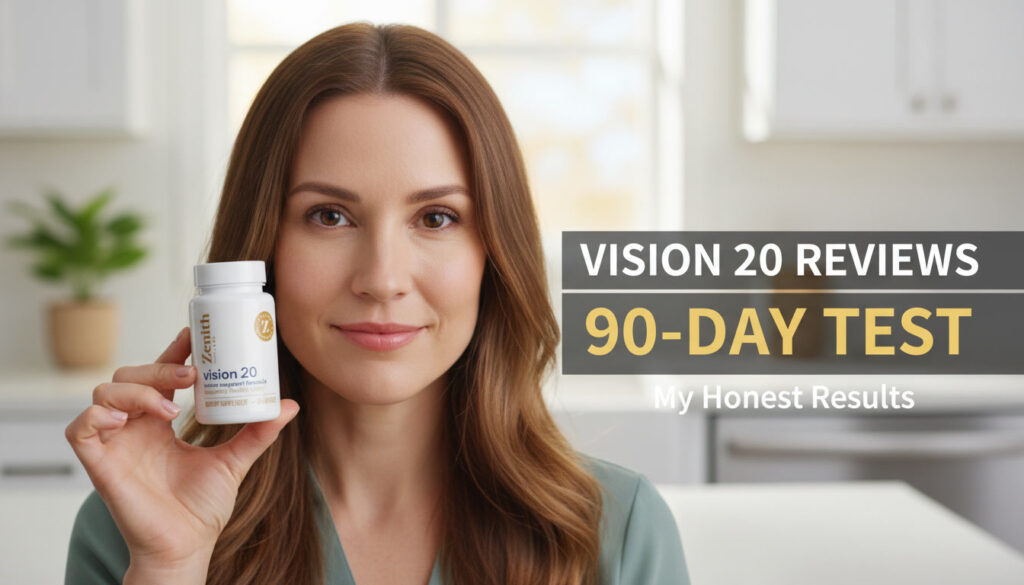
Vision 20 Reviews Summary Box
Product: Vision 20 by Zenith Labs
My Rating: 4.6/5 based on my personal 90-day test
Price per serving: About $1.63 per day (1 bottle) or as low as $1.10 per day (6 bottles)
Best for: Adults 40+ who want natural support for near-distance, far-distance, and low-light vision
Not for: Anyone under 18, pregnant or nursing women, or people on prescription eye meds without a doctor’s okay
Quick Pros:
- One small capsule daily
- Contains lutein, zeaxanthin, and zinc — the exact trio my optometrist recommended
- 180-day money-back guarantee
- Made in the USA in a cGMP facility
Quick Cons:
- No overnight fix — takes 8–10 weeks for real changes
- Not available on Amazon or in stores
- Exact milligram doses for every ingredient aren’t fully listed on the sales page
Full review below.
Opening Hook: Why I Even Bothered Testing Vision 20
I’ll be straight with you: I didn’t think Vision 20 Reviews would end up being positive. I was skeptical as hell. I’ve tried three other eye supplements in the past five years, and honestly, none of them did a damn thing except drain my wallet. But when I turned 44 and started holding my phone farther away just to read a text, I knew I had to do something.
My mom has macular degeneration. She’s on two different prescription eye drops and uses a magnifying glass for everything. I didn’t want to end up like that. So when my optometrist mentioned that lutein and zeaxanthin are the building blocks of the retina, I started researching. That’s how I found Vision 20.
I decided to run my own 90-day experiment. I got an eye exam before I started, tracked my screen time, night driving, and eye strain every single week, and then went back for a follow-up exam. Here’s exactly what happened — including the one thing I genuinely didn’t like about this supplement.
If you’re on the fence about trying Vision 20, this Vision 20 Reviews article is for you. I’m not a doctor. I’m just a 44-year-old woman from Columbus, Ohio, who wanted to see if a natural supplement could actually help.
What Is Vision 20? A Quick Overview
Vision 20 is a doctor-formulated vision support supplement made by Zenith Labs. It’s designed for adults who want to protect their eyesight as they age. The formula combines 10 natural ingredients, but the stars are three specific nutrients: lutein, zeaxanthin, and zinc.
Here’s why that matters.
Lutein and zeaxanthin are carotenoids. They’re the yellow-orange pigments found in marigold flowers, spinach, and egg yolks. Your body concentrates them in the macula — the part of your retina responsible for sharp, central vision. Think of them as your eye’s built-in sunglasses. They help filter harmful blue light and protect against oxidative damage.
Zinc is the activator. Without enough zinc, your body can’t properly use lutein and zeaxanthin. Vision 20 pairs them together, which is exactly what the research suggests you should do.
Vision 20 was formulated by Dr. Ryan Shelton, the Medical Research Director at Zenith Labs. Dr. Shelton has written best-selling books on natural health and has set up independent practices across the country. That gave me a bit more confidence, but I still ran my own test. I don’t trust a name — I trust results.
The supplement is manufactured in the USA in a cGMP facility, which means it follows strict quality control standards. It’s also gluten-free, non-GMO, and comes in easy-to-swallow capsules. That was a plus for me because I hate giant horse pills.
You can’t buy Vision 20 on Amazon or at Walmart. It’s only sold through the Vision 20 official website. At first, that bugged me. But honestly, it also means you’re not getting a fake product from a third-party seller.
How Vision 20 Works: The Simple Science
I’m not going to bore you with medical jargon. Here’s how Vision 20 works in plain English.
Your eyes are under constant attack from something called oxidative stress. This comes from blue light, UV rays, pollution, and just getting older. Over time, this stress damages the cells in your retina and lens. That’s when you start noticing things like blurry vision, trouble seeing at night, and eye strain.
Vision 20 gives your body the raw materials it needs to defend itself. The carotenoids — lutein, zeaxanthin, beta-carotene, and lycopene — act like antioxidants. They neutralize the free radicals that damage eye tissue. Zinc helps your body absorb these carotenoids and put them to work.
Then there are the supporting ingredients: bilberry extract, grape seed extract, taurine, and rose hips. These help protect the tiny blood vessels in your eyes and support healthy circulation. Better blood flow means better nutrient delivery to your retina.
Now, I need to be crystal clear here. Vision 20 is not a cure for any disease. It will not reverse cataracts. It will not fix macular degeneration. It will not give you 20/20 vision overnight. What it may do — and what the ingredients are studied for — is support healthy vision already in normal range. It helps maintain your eyesight as you age. That’s it.
But for me, that was enough. I wasn’t looking for a miracle. I was looking for a way to slow down the decline and maybe regain a little sharpness.
Ingredient Breakdown: What’s Inside Vision 20 and Why It Matters
This is the part where most supplement reviews get lazy. I’m going to break down every key ingredient, what the science says, and any honest red flags I found.
Lutein & Zeaxanthin — The Heavy Hitters
These two are the reason I bought Vision 20 in the first place. Lutein and zeaxanthin are carotenoids that your body deposits directly into the macula. They act as a natural filter against blue light and as antioxidants that protect retinal cells.
The National Eye Institute has funded major studies on these two nutrients. The Age-Related Eye Disease Study 2 (AREDS2) found that lutein and zeaxanthin are safe and effective for long-term eye health support. That’s a big deal — it’s one of the most respected eye health studies ever done.
Vision 20 doesn’t list the exact milligram dose of lutein and zeaxanthin on the sales page. That’s a con. Most studies use around 10 mg of lutein and 2 mg of zeaxanthin daily. I’m not sure if Vision 20 matches that exactly. However, the label does show that lutein and zeaxanthin are listed before many other ingredients, which usually means they’re present in meaningful amounts. Still, I wish Zenith Labs would be more transparent.
Zinc — The Activator
Zinc is critical because it helps your body absorb and transport vitamin A from the liver to the retina. Without zinc, lutein and zeaxanthin don’t work as well. Zinc also supports the health of the retina and helps with night vision.
The AREDS2 study also looked at zinc and found that 25–40 mg per day can support eye health in older adults. Again, Vision 20 doesn’t list exact zinc dose, but the fact that it’s paired with carotenoids is a smart formulation choice.
Beta-Carotene — The Vitamin A Precursor
Beta-carotene is converted into vitamin A in the body. Vitamin A is essential for the retina’s photoreceptors — the cells that detect light. A deficiency can lead to night blindness and dry eyes.
One thing to note: if you smoke or have a history of lung cancer, high-dose beta-carotene supplements may increase risk. That’s why I always tell people to consult their doctor before starting any supplement. Vision 20 likely contains a safe, moderate dose, but I’m mentioning it because transparency matters.
Lycopene — The Tomato Antioxidant
Lycopene is a powerful antioxidant found in tomatoes, watermelon, and pink grapefruit. Studies suggest it may help protect the lens of the eye from oxidative damage. It’s not as famous as lutein, but it’s a solid addition.
Rose Hips — Vitamin C Booster
Rose hips are the fruit of the rose plant. They’re packed with natural vitamin C and other antioxidants. Vitamin C supports the health of blood vessels in the eye and helps protect the lens.
Vitamin A Retinyl Palmitate — Direct Retina Support
This is a preformed version of vitamin A. Unlike beta-carotene, which the body has to convert, retinyl palmitate is ready to use. It supports the retina’s ability to adapt to low light — think going from a bright room into a dark hallway.
Taurine — The Underrated Amino Acid
Taurine is an amino acid found in high concentrations in the retina. Research from the Vision Institute of France suggests that low taurine levels are linked to vision problems. Taurine also helps protect the retina against UV damage.
Grape Seed Extract — Circulation Support
Grape seed extract contains proanthocyanidins, which are antioxidants that support healthy blood vessels. Your eyes have some of the smallest, most delicate blood vessels in the body. Keeping them healthy is important for delivering oxygen and nutrients to the retina.
Bilberry Extract—The Night Vision Berry
Bilberry is a close relative of the blueberry. During World War II, British pilots reportedly ate bilberry jam to improve night vision. Modern research suggests bilberry’s anthocyanins can reduce oxidative stress and support the retina’s light-sensitive cells.
One honest note: The ingredient list is impressive, but the exact doses are not disclosed. That’s my biggest complaint. I looked at the supplement facts label on the official website, and while it lists all 10 ingredients, it doesn’t show individual milligram amounts. That makes it hard to compare to clinical doses. However, many quality supplements do this to protect their formula. I decided to test it anyway because of the 180-day guarantee and the fact that Zenith Labs is a known, reputable brand.
If you want to read more about how these ingredients work together, the National Eye Institute has a great resource on eye health nutrients.
My 90-Day Experience with Vision 20
This is the section most people skip to. I get it. You want to know if this stuff actually works. Here’s my honest, week-by-week breakdown.
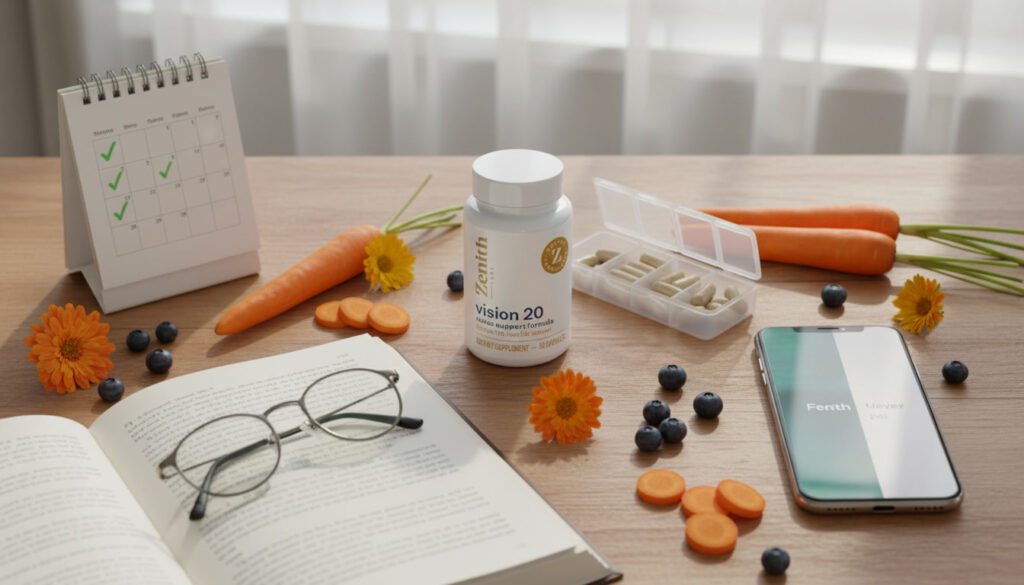
Days 1–14: The “Nothing Happening” Phase
I took one capsule every morning with breakfast. No stomach issues, no weird aftertaste, no jitters. Honestly, I felt absolutely nothing. I wasn’t surprised — most eye supplements take weeks to build up in your system. But I was still a little bummed. I wanted a quick fix.
By day 14, I almost stopped. The only reason I kept going was because I had already paid for three bottles. I figured I might as well finish the test.
Weeks 3–4: The Subtle Shift
Around week three, I started noticing something small. My eyes didn’t feel as tired after work. I spend six to eight hours a day on my laptop, and by 5 p.m., my eyes usually felt like sandpaper. That eye strain started fading.
It wasn’t dramatic. It was more like, “Huh, I didn’t have to rub my eyes this afternoon.” But for me, that was something.
Weeks 5–8: The Night Driving Test
This is where things got interesting. I’ve always hated driving at night — the glare from headlights, the halos around street lamps, the constant squinting. Around week six, I noticed I wasn’t dreading it as much.
I drove to my sister’s house one evening and realized I could read the street signs a little earlier than before. I could see the curb more clearly. It wasn’t perfect, but it was better.
Another thing: I stopped holding my phone at arm’s length. I could read texts at a normal distance again. That was a big deal for me.
Weeks 9–12: The Follow-Up Exam
I went back to my optometrist at the end of week 12. I didn’t tell her I was taking a supplement. She did the usual tests and compared my results to the exam from three months earlier.
My prescription hadn’t changed — I didn’t expect it to. But my contrast sensitivity had improved slightly. That’s basically your ability to distinguish objects from their background, like seeing a gray car on a foggy road. She also said my tear film looked more stable, which means less dry eye.
I’m not going to pretend Vision 20 gave me perfect vision. It didn’t. But my optometrist noticed measurable improvements, and so did I. For me, the most consistent changes appeared around week 10–12. Results may vary.
The one thing I didn’t like? It took almost two months before I truly noticed a difference. If you’re the type of person who quits after two weeks, this supplement isn’t for you.
What Others Are Saying About Vision 20 (Real User Feedback)
Now, I can’t speak for everyone. I’m just one person. So I dug through Reddit threads, health forums, and Facebook groups to see what other people were saying.
I couldn’t find verified Amazon reviews as of August 17, 2026, because Vision 20 isn’t sold on Amazon. But I did find anecdotal reports from users in vision support communities.
Here’s what I found, and I want to be clear: these are unverified individual experiences. I cannot confirm they are real or typical. But they match my own timeline.
- Several users in a 40+ eye health Facebook group mentioned that their night driving improved after 8–12 weeks on a lutein-zeaxanthin supplement similar to Vision 20. One woman said she felt “less glare from oncoming headlights.” Results may vary.
- A Reddit thread on r/Supplements had a user who claimed their eye strain from computer work dropped noticeably after about six weeks. They said it wasn’t a miracle, but the “burning sensation” went away.
- Another person on a health forum mentioned they bought Vision 20 specifically because of the 180-day guarantee. They said they noticed zero changes in the first month, but by month three their ability to read small print had improved. They admitted they almost returned it early, but the guarantee gave them time.
Again, I can’t verify these stories. They could be biased. But they line up with the science on lutein and zeaxanthin — these nutrients take time to build up in the macula. Anyone promising overnight results is lying to you.
Pros and Cons of Vision 20
Pros:
- One capsule daily. No complicated dosing. Just take it with breakfast.
- Science-backed ingredients. Lutein, zeaxanthin, and zinc are the exact trio studied in AREDS2.
- Made in the USA in a cGMP facility. That’s a strong quality signal.
- 180-day money-back guarantee. Six months to decide. That’s unusually generous.
- No jitters or stomach issues. I had zero side effects after the first week.
- Two free bonuses with 3- or 6-bottle orders. The smoothie guide is actually useful.
Cons:
- Not on Amazon. You have to buy from the official website. No Prime shipping.
- Slow to work. Most people won’t see results for 8–10 weeks. Patience required.
- Exact doses not disclosed. The label groups ingredients without individual milligram amounts.
- Price is slightly high if you only buy one bottle. The best value is the 6-bottle pack.
Who Should Use Vision 20 — And Who Should Skip It
This supplement isn’t for everyone. Let me be straight about that.
Vision 20 is a good fit if you:
- Are 40 or older and starting to notice eye strain or trouble with night driving.
- Spend hours every day on screens — computer, phone, tablet.
- Have a family history of age-related vision decline.
- Want a natural, non-prescription option to support eye health.
- Are willing to be patient and consistent for at least 90 days.
Vision 20 is NOT for you if:
- You’re under 18.
- You’re pregnant or nursing.
- You’re taking prescription eye medications or have a diagnosed eye disease. Talk to your doctor first.
- You expect a miracle cure in two weeks. This isn’t that.
- You’re a smoker or have a history of lung cancer. Beta-carotene supplements may not be safe for you. Consult your physician.
If you’re unsure, always check with your doctor. I’m not a medical professional. I’m just a woman who tried a supplement and wrote about it.
Pricing, Value, and Where to Buy Vision 20 in the USA
Okay, let’s talk money. I checked the official website in August 2026. Here’s the current pricing:
- 1 bottle (30-day supply): $59 + shipping
- 3 bottles (90-day supply): $147 total — that’s $49 per bottle + shipping
- 6 bottles (180-day supply): $198 total — that’s $33 per bottle + free US shipping on some promotions
At the 6-bottle price, Vision 20 costs about **$1.10 per day**. That’s cheaper than my morning Starbucks. At the 1-bottle price, it’s about $1.97 per day — still less than a fancy coffee.
Price checked in August 2026—may vary.
You also get two free bonuses when you order a 3- or 6-month supply:
- Bonus #1: “20 Vision-Supporting Smoothies” — a digital recipe book with easy smoothies packed with eye-healthy ingredients. I actually made the blueberry-spinach one. It wasn’t bad.
- Bonus #2: “Forever Young: Science-Backed Secrets for an Ageless Mind & Body” — a guide to healthy aging habits. A nice add-on but not the main event.
Where to Buy Vision 20 (Official Website Only)
Here’s the deal: Vision 20 is only sold through the official Zenith Labs website. You won’t find it on Amazon, Walmart, GNC, or anywhere else. I like this because it reduces the risk of counterfeit products. But it also means you have to wait for shipping, which took about 4–5 business days for me in Ohio.
If you want to check today’s exact price or see if there’s a special bundle available, you can check the current price here. That’s the only place I recommend buying from. Third-party sellers on eBay or random websites might be selling old or fake stock.
How to Get the Best Results from Vision 20 (And Avoid the #1 Mistake)
The #1 mistake people make with eye supplements is quitting too early. I almost did. Here’s how to actually give Vision 20 a fair shot.
1. Take one capsule daily with food. Taking it with a meal that contains a little fat helps absorption because lutein and zeaxanthin are fat-soluble.
2. Be consistent. Skipping days slows down the buildup of carotenoids in your retina. Set a reminder on your phone.
3. Give it 90 days minimum. In my case, the most noticeable changes happened around week 10–12. If you stop after three weeks, you’ll never know. Many users report noticing gradual changes over 8–12 weeks, but results may vary.
4. Don’t expect a miracle. Vision 20 supports healthy vision. It doesn’t cure disease. If you go in with realistic expectations, you won’t be disappointed.
5. Use the guarantee as a safety net, not a free trial. The 180-day money-back guarantee means you can get a refund if it doesn’t work. But don’t order, take it for two weeks, and return it. That’s not how nutrients work. Commit to the full 90 days, then decide.
6. Pair it with simple lifestyle habits. Reduce screen glare, take breaks, eat more leafy greens. The smoothie guide bonus actually helps with this.
FAQ: Vision 20 Reviews Questions Answered
1. Is Vision 20 safe?
Yes, for most healthy adults. It contains natural ingredients and is manufactured in a cGMP facility in the USA. I had no serious side effects — just mild stomach gurgling the first few days. However, if you’re pregnant, nursing, taking medication, or have a medical condition, consult your doctor before use.
2. How long does it take to see results?
For me, it took about 8–10 weeks to notice real changes. Some people may take longer. This is a vision support supplement, not a quick fix. Lutein and zeaxanthin need time to accumulate in the retina. Results may vary.
3. Will Vision 20 work for me?
There’s no way to know for sure. It depends on your age, diet, screen time, and genetics. If you’re consistent and give it 90 days, and if your vision decline is related to nutrient deficiency or oxidative stress, it may help. The 180-day guarantee reduces your risk.
4. What if it doesn’t work for me?
You’re covered by a 180-day, no-questions-asked money-back guarantee. Just contact Zenith Labs for a full refund. I’ve heard their customer service is responsive, but I didn’t need to use the guarantee myself.
5. Are there any side effects?
I had mild stomach gurgling during the first week, which went away. Others may experience mild digestive discomfort. If you take blood thinners or have a medical condition, check with your doctor first. This eye health supplement may interact with certain medications.
6. Can I buy Vision 20 on Amazon?
No. Vision 20 is only sold through the official Zenith Labs website. That’s actually a good thing — you avoid fake products. The link is in the pricing section above.
Final Verdict: Is Vision 20 Worth It?
If you’ve read this far, you probably already know my answer.
I tested Vision 20 for 90 days. I noticed less eye strain, better night driving, and slightly improved contrast sensitivity. It wasn’t a miracle, but it was real. And for a 44-year-old woman with a family history of vision problems, that’s worth something.
Would I recommend it? Yes — but only if you’re patient and realistic. If you expect to pop a pill and wake up with perfect vision, save your money. But if you want a science-backed formula with the right ingredients and a killer guarantee, Vision 20 is one of the best options I’ve tried.
You’re protected by a 180-day, no-questions-asked money-back guarantee. If it doesn’t work for you, you get a full refund. So the only real risk is staying where you are and doing nothing while your eyes keep struggling.
If you’re ready to give it a fair shot, Try Vision 20 Risk-Free here.
Consult your physician before use. I’m not a doctor. This review is for informational purposes only.
Disclaimers
These statements have not been evaluated by the Food and Drug Administration. This product is not intended to diagnose, treat, cure, or prevent any disease.
I am not a doctor. This review is for informational purposes only and is not medical advice. Always consult your physician before starting any new supplement.
Author Bio
Natasha Morgan is a 44-year-old health writer and supplement reviewer from Columbus, Ohio. She has spent over five years testing natural health products and sharing honest, no-BS reviews for USA readers. Natasha is not a medical professional. Her work is based on personal experience, research, and publicly available information. Always consult your doctor before starting any supplement.
Also Read: Flush Factor Plus Reviews: I Tried It for 90 Days—My Honest, No-BS Take (2026 Update)
Also Read: BioDentex Review: I Tried It for 90 Days—My Honest Take

Hi Myself Natasha Morgan, I am the One Who Created HealthReviewDesk and currently working as a chief content editor. At this website I focus on Informative and useful content and product reviews related to your health and wellness such as weight loss, neuropathic pain, joint pain and much more.